Guide to coloring page of Farm animals cartoon style
Embarking on a creative journey with a Coloring page of Farm animals cartoon style presents a fantastic opportunity to explore vibrant colors and simple shading techniques. This collection of charming barnyard residents, presented in a delightful cartoon aesthetic, invites colorists of all levels to bring them to life. It is noted that the bold outlines and clear shapes make this an ideal canvas for practicing solid color application and introducing basic depth, enhancing the inherently cheerful nature of these animal portrayals.
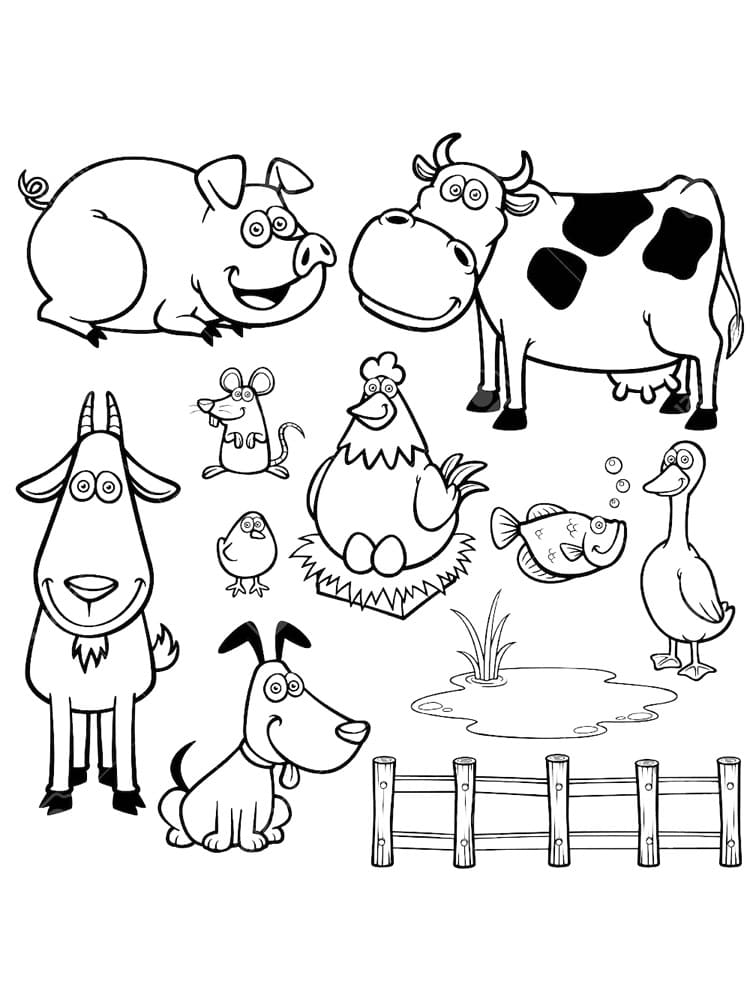
Consider the large pig, confidently posing on all fours with a wide, friendly grin. For this character, a classic light pink is the go-to, perhaps with a slightly darker rose hue used for subtle shading under its belly and chin, or inside the ears to give them a bit more dimension. The curly tail can be kept simple, a fun detail. Adjacent to it, the cow stands tall, depicting a standard dairy cow with its distinct patches. While the outlines are there, it is recommended to apply a creamy white for the main body and a deep, rich black for its characteristic spots. A touch of pale grey can be used under the udder and along the lower parts of its legs to ground the figure, giving it a sense of weight without overcomplicating the cartoon style.
Moving to the more upright figures, the goat stands facing forward, distinguished by its long beard and horns. A creamy white or light tan would be appropriate for its coat. One can add a faint brownish-grey for the beard and a slightly darker brown for the horns, perhaps with a highlight along the ridge to suggest their texture. The mouse, perched on its hind legs, offers a chance for softer hues. A light grey or even a pale brown could be chosen, with a touch of light pink for its inner ears and nose. Simple shading on its underside or behind an ear can provide a quick sense of volume.
The hen, comfortably settled on a nest with two eggs, is a central figure. A warm brown or a reddish-brown for her feathers would look lovely, with a brighter red for her comb and wattles. To create a fluffy appearance, one might use very light, feathery strokes if employing colored pencils, or subtle variations in the base color. The eggs in the nest are typically a cream or pale brown, and the nest itself can be colored with various shades of straw-like yellows and browns, building up a layered texture. The small chick near the hen calls for a bright, cheerful yellow, with just a hint of orange for its beak and feet.
The loyal dog, sitting with an eager expression and a visible collar, often suits a sandy brown, golden retriever-esque hue, or a classic black and white if one prefers a Dalmatian or Border Collie look. A darker shade of the chosen body color can be used for shading around its legs and under its jowls, emphasizing its friendly snout. The collar provides an opportunity for a contrasting color, such as a bold red or blue. The duck, standing gracefully, is best rendered in a pure white or a very pale grey, with a vibrant orange for its beak and webbed feet, allowing these features to truly pop against its body.
Further enriching the scene, the aquatic elements add another dimension. The small fish with its playful bubbles would benefit from bright, iridescent colors. A vibrant orange, a shimmering blue, or even a multi-colored approach with scales highlighted by different hues would suit its cartoon nature. The bubbles can be left white or given a very faint blue tint to imply transparency. The pond itself can be a serene blue or greenish-blue, with slightly darker areas for depth, especially near the edges. The reeds within the pond are best colored in varying shades of green, with a deeper green at the base and a lighter, fresher green towards the tips.
Finally, the wooden fence provides a great opportunity to anchor the scene. It is recommended to use various shades of brown for the wooden posts and rails, perhaps a medium brown as the base with a darker brown for shadows, especially where the planks meet or on the underside of the crossbeams. A faint wood grain texture can be implied with a few darker lines. The ground beneath the animals can be a vibrant green for grass, with subtle variations to imply texture, and a clear blue sky above completes the pastoral setting. Remember, for this cartoon style, strong, clean colors are key.
In conclusion, working on this Coloring page of Farm animals cartoon style is about having fun with color and bringing out the inherent charm of each character. It is advised to use bright, clear colors, apply simple shading for depth, and perhaps add a touch of white highlight to eyes or wet noses to give them a lively sparkle. The goal is to create a cheerful, vibrant farm scene that radiates warmth and personality, making the most of these endearing cartoon designs.