Analyzing Luke Hobbs (Dwayne Johnson): A Coloring Masterclass
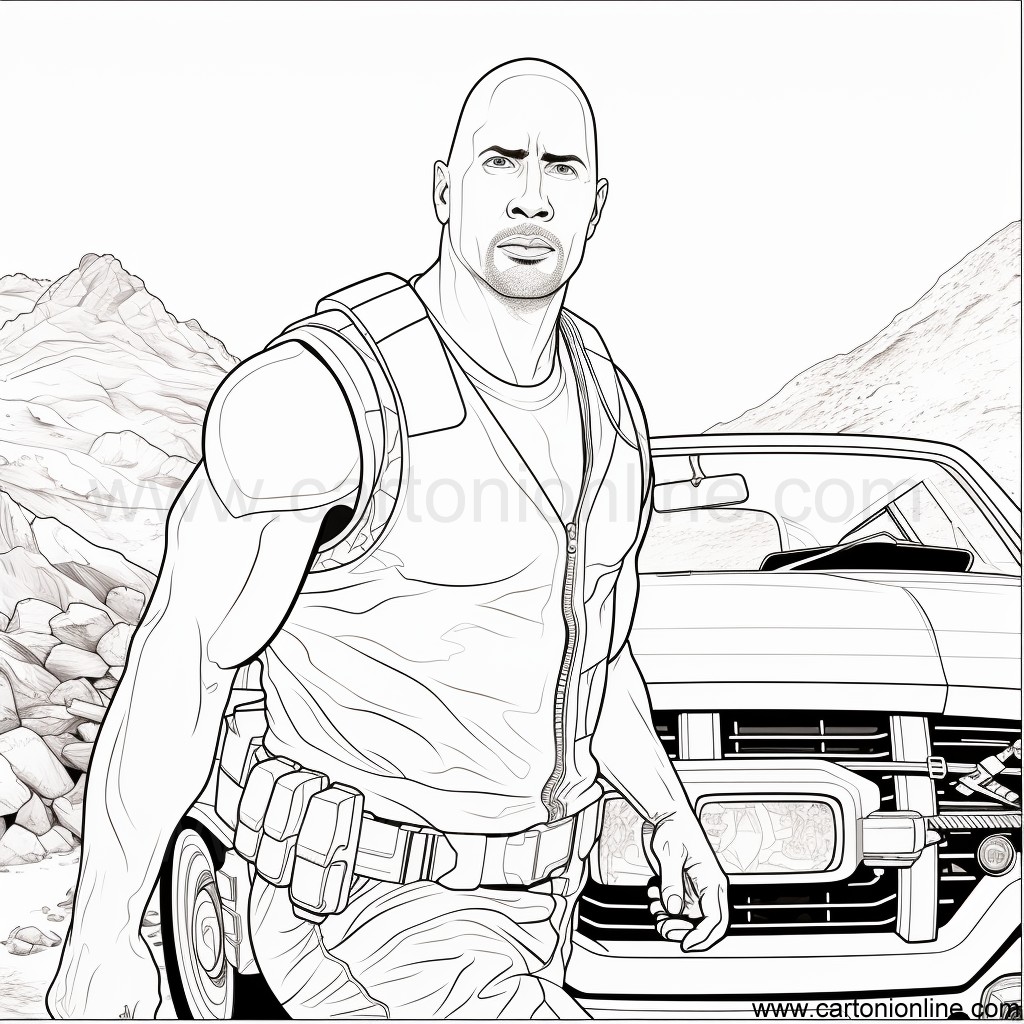
Right off the bat, you're looking at a quintessential Luke Hobbs – pure intensity and ready for anything. His pose isn't static; it feels like he's just paused mid-action, stepping forward with that characteristic powerful stride. The slight turn of his body and the subtle bend in his left arm (viewer's right) suggest a coiled energy, a readiness to engage. This isn't just a tough guy; this is a highly capable operative, and your coloring needs to convey that.
His expression is all business: narrowed eyes, slightly furrowed brow, and a firm, unsmiling mouth. To capture this, pay close attention to the subtle lines around the eyes and mouth. For shading his face, think strong, directional light to accentuate his chiseled features. A light source from above-left would carve out the cheekbones, jawline, and the impressive musculature of his neck and shoulders. Use a base of warm medium brown for his skin, then build up darker browns for shadows, especially under the brow ridge, along the jaw, and beneath the nose and lower lip. Highlights on the forehead and the bridge of the nose will add dimensionality.
The stubble beard requires careful handling; don't just use a flat grey. Consider tiny, dark dots or very short, fine strokes with a dark grey or black pencil to give it texture and depth, making it feel less like a solid patch and more like actual hair follicles. For his bald head, subtle shading is key to define the skull's curvature; light shadows on the sides and back will prevent it from looking flat.
Moving to his gear, the tactical vest and utility belt scream functionality. For the vest, a military-grade olive drab, desert tan, or even a dark charcoal grey would be spot on, especially considering the desert background. Use deep shadows in the folds and where the straps meet the main body to emphasize the bulk and layering. The undershirt can be a darker, contrasting neutral like black or dark grey, again with careful attention to wrinkles and folds for realistic shading.
The utility belt, laden with pouches, presents fantastic opportunities for detail. Match the belt color to the vest or go slightly darker. Each pouch should be individually shaded to give it volume, suggesting a sturdy, packed item. The metal buckles and plastic clips on his gear will benefit from sharp highlights against a darker base, implying a metallic or hard plastic sheen.
Finally, the background elements. The mountainous terrain calls for sandy browns, ochres, and desaturated greys, possibly with a cooler grey for mountains further in the distance to suggest atmospheric perspective. The truck, an imposing vehicle, could be a rugged metallic grey, matte black, or even a desert-appropriate tan. Remember to use reflective techniques for the grille and headlights: bright whites and light greys with a hint of blue for chrome, and a warm glow if you're implying active lights. The windshield should reflect the sky, perhaps a light blue or grey. Each element, from Hobbs himself to the surrounding environment, should be rendered with purposeful light and shadow to create a cohesive, impactful scene.