Mastering Huggy Wuggy 25: A Coloring Deep Dive
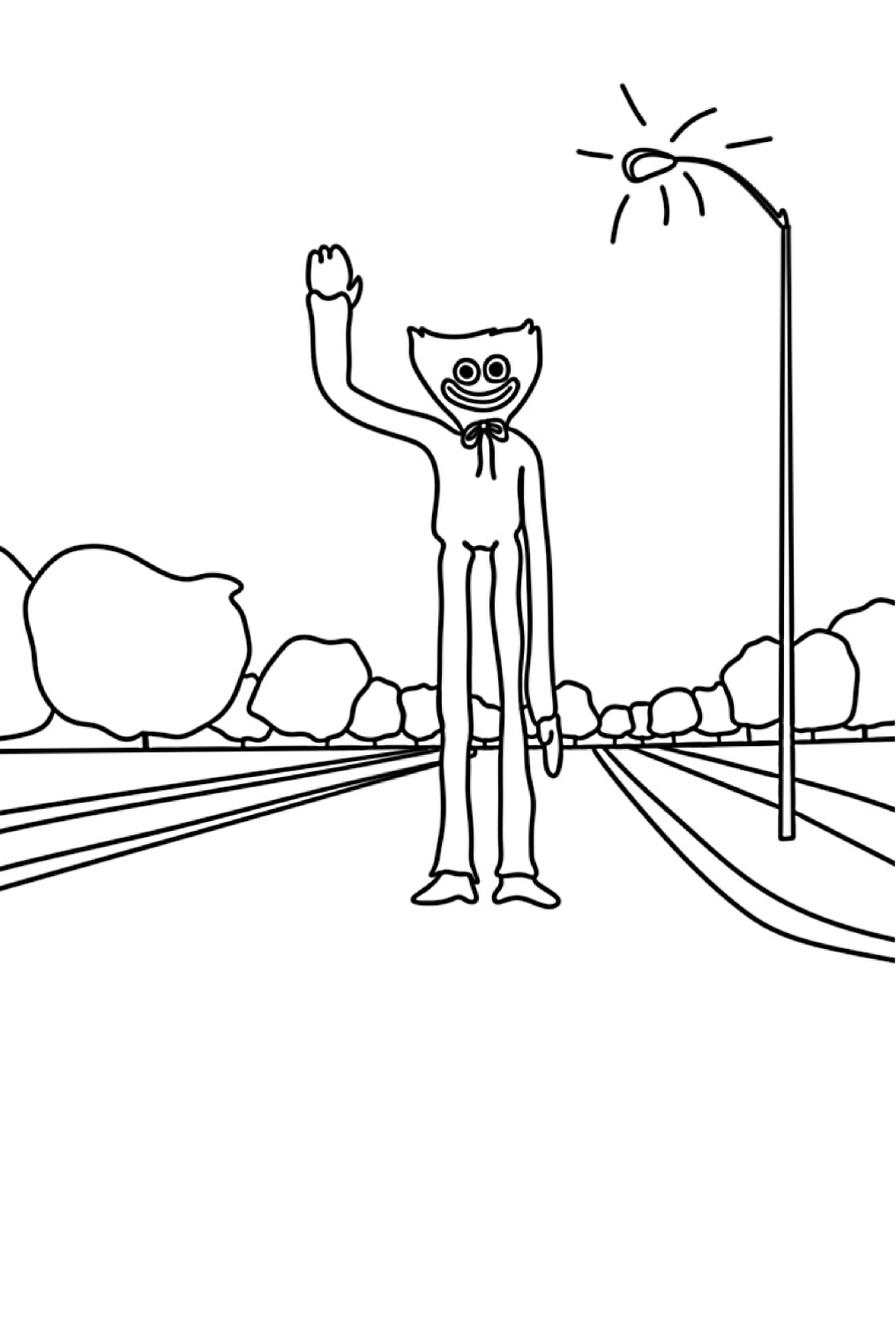
Right away, you've got a fantastic canvas for Huggy Wuggy 25, caught in a surprisingly friendly, almost inviting pose. He's standing tall, typical of his lanky build, with one hand raised in a clear wave. This gesture alone gives you a solid foundation for interpreting his mood. Is it a genuinely welcoming wave, or something more sinister masked by a wide grin? That's your first creative decision point for conveying character.
Look at that grin. It's classic Huggy Wuggy – broad, toothy, and those big, round eyes convey an almost unnerving cheerfulness. For the eyes, think about giving them a slight glimmer. A small white dot for a catchlight in the top corner of each pupil will add life and intensity, making them pop against the traditional black of the pupils and the white of the sclera. His bow tie is a crucial detail; keep that a vibrant red to contrast sharply with his primary body color.
When it comes to the main body, you're obviously working with that iconic Huggy Wuggy blue. Don't just settle for one flat shade. This is your chance to really push the texture. Imagine a soft, plush fur. To achieve this, use varying shades of blue. Start with a medium blue as your base, then build up darker blues in the areas where shadows would naturally fall – under the chin, along the inner edges of his limbs, and on the side opposite your imagined light source. For highlights, use a lighter blue or even a very light grey-blue on the most prominent surfaces, like the top of his head or the front of his waving arm. This layering creates depth and makes the fur feel almost tangible.
Now, let's talk about that environment. The perspective on the road lines is a killer opportunity to really sell the depth. Use progressively lighter or desaturated greys and browns for the road as it recedes into the distance. The bushes lining the path offer a chance for some natural texture. Foreground bushes should be a richer, darker green, perhaps with some individual leaf strokes to suggest foliage. As they get further away, make them lighter, hazier greens to enhance that atmospheric perspective. This trick makes the scene feel vast and pulls the viewer's eye towards Huggy Wuggy 25.
The streetlamp is a major light source. This is where your shading strategy truly comes into play. The pole itself can be a dark metallic grey or black. The light emanating from it should be a warm, soft yellow or orange. Crucially, consider how that light affects everything around it. Areas closest to the lamp would be brighter, and shadows would be cast away from it. Notice the light rays drawn; these are perfect guides. Create a subtle glow effect around the lamp itself, perhaps with a soft yellow wash that fades outwards. Remember to shade the ground directly under the lamp as being brightly lit, with objects further away gradually falling into shadow.
Think about the overall mood. With Huggy Wuggy and that streetlamp, you could go for an eerie twilight scene with deep blues and purples in the sky, or a crisp night with clear stars. Shadows on the ground, particularly those cast by Huggy Wuggy himself, should be sharp and well-defined if the light source is strong. A subtle gradient on the ground, transitioning from light near the lamp to darker further away, will ground the entire scene beautifully. Don't be afraid to experiment with your palette; this piece has all the elements for a truly engaging visual story.