Unpacking the Dual Nature of Huggy Wuggy
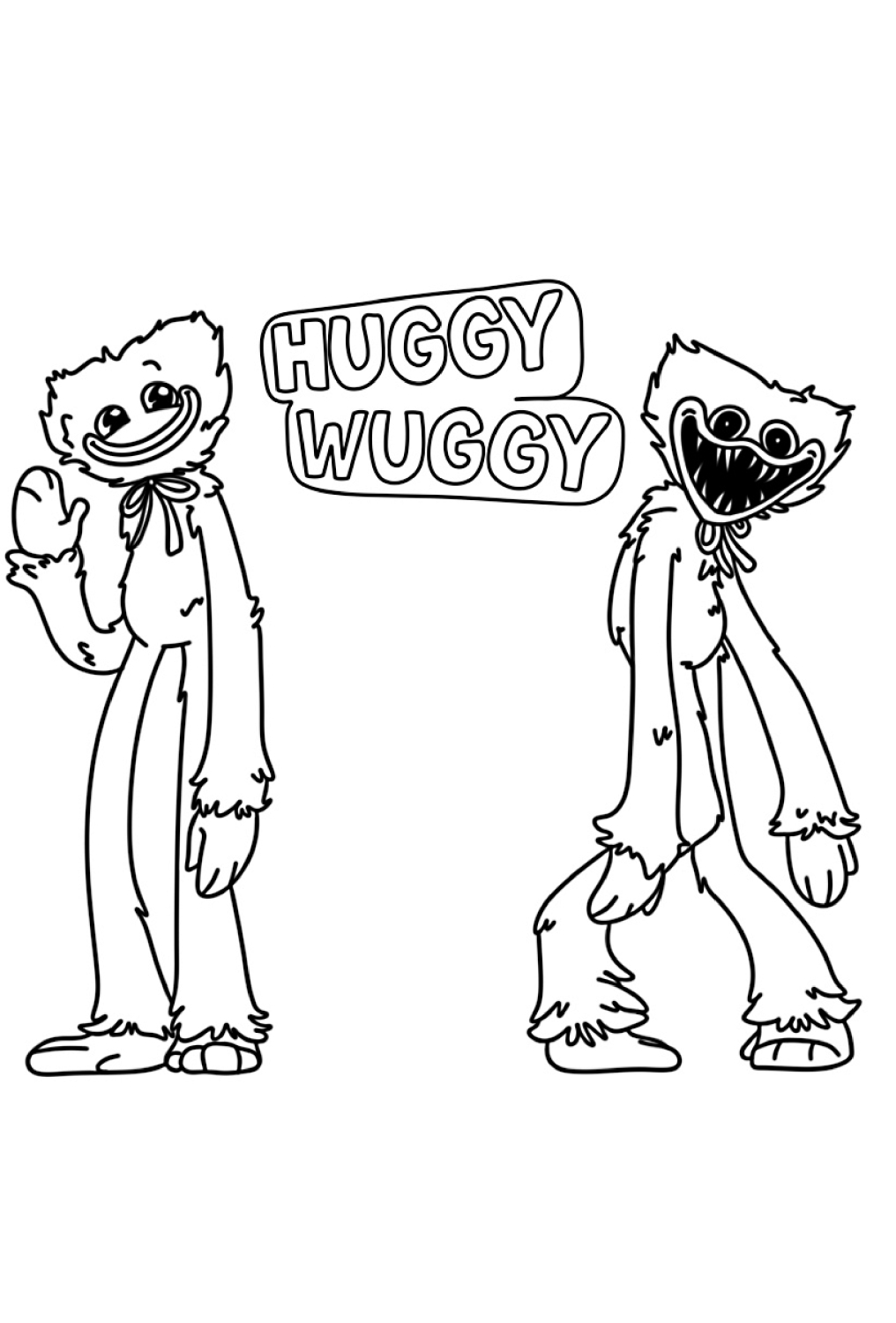
Diving right into these two renditions of Huggy Wuggy reveals a masterclass in conveying contrasting emotions through simple line art. It’s not just a character; it’s an exploration of his iconic duality, offering fantastic opportunities for colorists to play with mood and depth. The left figure presents an inviting, almost innocent persona, while the right perfectly captures the chilling, predatory side we know so well. This juxtaposition is what makes this particular representation so compelling.
Consider the character on the left first. His pose is remarkably open and friendly. Standing tall, with a gentle lean, he extends a welcoming hand, almost as if waving hello. His head is slightly tilted, contributing to that approachable demeanor. The expression is key here: a wide, almost goofy smile stretches across his face, with eyes narrowed slightly in what appears to be pure delight. There’s a softness to the overall stance, hinting at the initial, seemingly benign facade of Huggy Wuggy.
When coloring this 'friendly' version, think vibrant, comforting blues for the fur. Use a lighter hand on areas catching direct light – top of his head, front of his body, raised hand. For shading, subtle gradients are key. Imagine soft light casting gentle shadows under his chin, beneath his arms, and along the inner curves of his legs. The mouth could be a warm pink for gums, with white teeth, keeping the overall tone light and inviting. His eyes, perhaps a lighter blue or black, should retain that innocent sparkle; a tiny white reflection dot can achieve this effect brilliantly.
Now, shift your focus to the figure on the right – a complete emotional flip. This is the menacing Huggy Wuggy 30, a creature on the prowl. His pose is a hunched, forward-leaning gait, suggesting a creeping movement, an ominous advance. His head is angled down and to the side, emphasizing a predatory stare. The arms are slightly bent at the elbows, poised, ready for action. It’s a posture that screams 'danger' and 'pursuit,' a stark contrast to the previous figure's welcoming gesture.
The expression on this right figure is where the true horror manifests. His mouth is agape, a terrifying cavern revealing rows of sharp, dagger-like teeth. Those eyes are wide, unblinking, filled with an intense, perhaps manic, focus. There's no friendliness here; only an insatiable, hungry gaze. This is the moment the facade drops, and the true nature of the character is exposed in all its terrifying glory.
For coloring this menacing iteration, lean into darker, more saturated blues for the fur. Deep indigo or navy hues create a sense of dread. Shading should be bolder, more pronounced. Imagine harsh, dramatic shadows clinging to the undersides of his limbs, the deep recesses of his fur, and especially within that gaping maw. The mouth needs to be an abyss – deep black for the interior, with stark white or off-white teeth that truly pop. Gums can be a visceral, dark red. His eyes? Keep them dark and intense; a slight reddish tint around the pupils adds to the malevolent feel. For both figures, remember to use short, feathered strokes when coloring the fur, giving it that tactile, shaggy texture and realistic depth to these otherwise flat line drawings. Think about fur direction to guide your strokes, enhancing the character's form and menace.