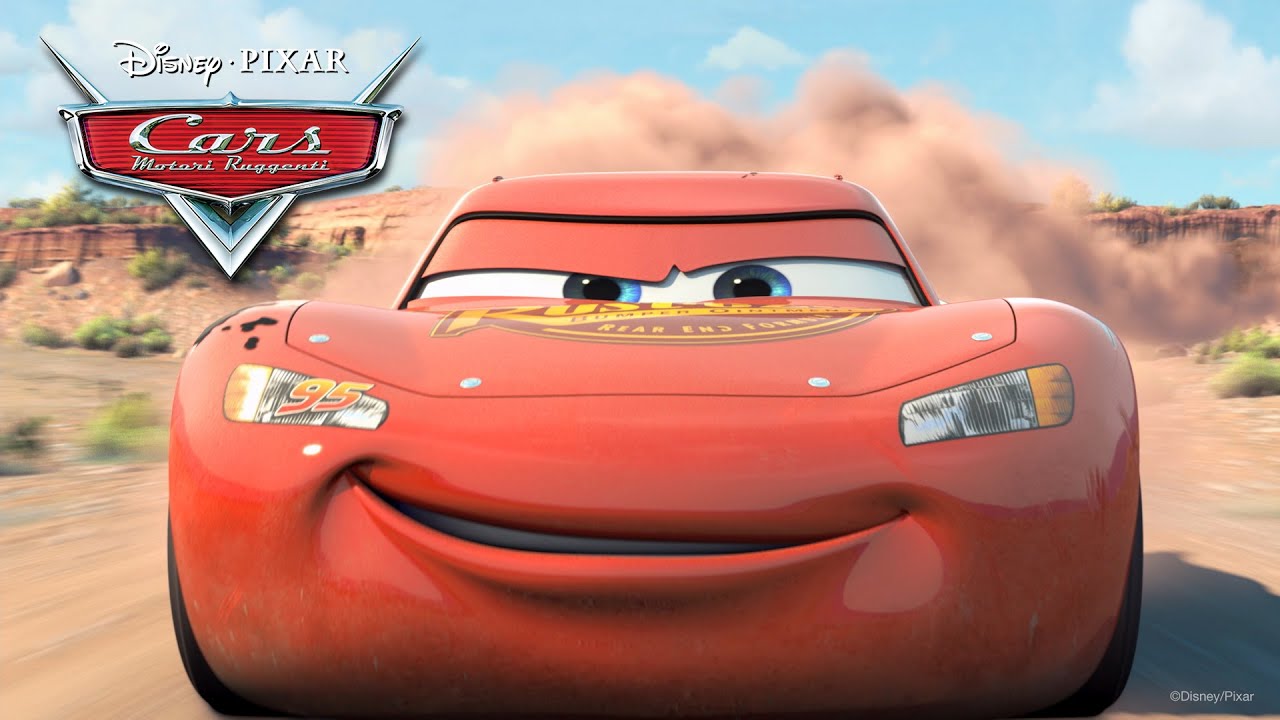
Video of Cars Motori Roarenti - "Lightning races against Doc"
Lightning competes against Doc | Cars Roaring Motors
There are scenes in animated films that go beyond simple entertainment: they become small life lessons, moments that remain etched in our memory because they speak of growth, humility, and change. One of these is certainly the race between Lightning McQueen and Doc Hudson in Cars – Roaring Engines (2006), the Pixar masterpiece that gave voice and soul to engines, transforming the asphalt into a stage of emotions.
Anyone who's seen the movie knows: Lightning McQueen, a promising young racing driver, is an arrogant race car, focused only on one thing—winning. He's the classic protagonist who thinks he knows it all, and because of that, ends up understanding nothing. After a (literally) accident, he finds himself stuck in Radiator Springs, a tiny village forgotten by Route 66. And it is here that it meets Doc Hudson, the old local judge, apparently an ordinary car… but which hides a glorious past.
The old champion and the arrogant young man
The race scene between the two is the moment when intergenerational tensions explode. McQueen doesn't understand why he should listen to an "old" car like Doc. It's fast, it's modern, it's built to win: what on earth can that blue wreck teach him?
Doc, however, knows the guy well. He too was young, he too was invincible. And he knows that arrogance is just another form of naivety. So he decides to challenge him on his own ground: a desert race, on a dirt track full of curves, dust, and unexpected events. The reward? Honor, but above all, a wonderful life lesson.
The moment of the disaster curve
It's in that scene that Pixar works its magic. Everything seems to be leading McQueen to victory: he takes off in a trumpet, mocks Doc, and speeds away with the confidence of someone who believes that speed is enough to conquer everything. But then comes... the hairpin bend, that famous scene that every fan of Cars remember.
Doc tackles it with elegance, gliding across the dirt as if dancing. McQueen, on the other hand, doesn't brake, doesn't balance, doesn't listen. And the result? A spectacular spin, a cloud of dust, and the thud of a deflating ego.
It's a comical moment, yes, but also a profoundly human one. That missed skid is the perfect synthesis of his inexperience: he thinks he has everything under control, but he hasn't learned yet. to “feel” the trackAnd Doc, standing there watching him, doesn't laugh. He simply observes him, like a teacher who knows his student will have to make a hundred mistakes before truly understanding.
A lesson hidden in the dust
That race is not just a duel between two cars: it is a comparison between two visions of lifeMcQueen races to finish first, Doc races to figure out where he is. The young man sees the track as an obstacle, the old man as a traveling companion.
And this is where Cars It becomes surprisingly profound. Because behind the bright colors, the jokes, and the rock music, there's a message about slowing down, learning to look around, listening to those who lived before us. Radiator Springs is a place frozen in time, but it's also the symbol of a world that modernity has forgotten. McQueen has to pass through there not by chance, but by remember what running really means.
Direction and animation: a ballet of sand and engines
From a technical standpoint, that sequence is a little gem. Pixar, at the time, had already demonstrated that it could animate everything—toys, fish, monsters—but with Cars It had surpassed itself. The suspension bending, the dust rising, the sunlight reflecting on the bodywork: everything was taken care of down to the smallest detail to make that race seem viva, full of vibrations and realism.
Yet, it's not just a matter of technique. There's a clever directorial choice: the camera follows the curves as if it were an invisible drone, but at the same time remains "low," close to the asphalt. This point of view makes the viewer feel inside the scene, as if they were racing along with them. When McQueen skids and kicks up dust, you almost feel it on your face.
The weight of experience
Doc Hudson, with his calm voice and his "seen it all" look, is the personification of forgotten wisdom. He doesn't impose, he doesn't shout, he doesn't demand respect: he simply gets it. showing that you know how to do itIn that race, he doesn't need to win — he just needs to make McQueen understand that speed without control is nothing.
And this is a powerful theme, one that Pixar has managed to incorporate naturally, without rhetoric. When Doc finishes the race and McQueen is left in the dust, the young champion's expression is priceless: he still doesn't understand what happened, but something inside him cracks. It's the first step toward his transformation.
Rivalry that becomes respect
Later in the film, that scene will be replayed. McQueen will learn to take that same turn, recalling Doc's words: “Turn right to go left.” It's a paradox, but also a perfect metaphor: to grow, we often have to learn to do the opposite of what seems right.
When McQueen eventually uses that technique to help another driver, we'll understand that Doc's lesson hasn't been lost. And that first desert race will become the symbol of his transformation: from arrogant racer to true champion.
A small moment, a huge meaning
The race between Lightning and Doc lasts only a few minutes, but it contains the entire message of the film. It is not just a racing scene, but a metaphor about time, listening and memoryThis is the point where Pixar, beneath the patina of shiny metal and smoking tires, reminds us that even in the world of motors there are emotions, fragility and second chances.
At bottom, Cars It's not really about cars, but about people. And that dusty desert race tells us that the fastest doesn't always go the furthest.
Because, as Doc Hudson would say, “It's not enough to know how to run. You have to know why.”